
The Science of EV Windscreens: How Electric Vehicles Are Changing Auto Glass Forever
It is no secret that the advent of consumer Electric vehicles have brought about something of a quiet revolution on Irish roads. Without the familiar rumble of a traditional combustion engine, drivers notice less background noise, but that silence creates new challenges for the glass surrounding the cabin. In the last few years, EV windscreens have become increasingly sophisticated components designed to contribute to comfort, safety, aerodynamics to the benefit of EV drivers around the country.
The rise of electric vehicle auto glass reflects just how much vehicle design has changed of late. It is increasingly common for Modern EVs to feature acoustic glazing, panoramic roofs, solar-control coatings and complex camera systems incorporated into their windscreens. At the same time, heavier battery packs and highly aerodynamic body shapes have been shown to place greater demands on car glass and pose new challenges on its installation.
For drivers, that means replacing an EV windscreen can involve considerably more than fitting a piece of glass and sending the car on its way. From acoustic comfort to ADAS technology, today’s windscreen is becoming an important part of the vehicle’s overall engineering.
The Latest Innovations in Electric Car Technology You Need to Know About >>
Why are EV windscreens different?
EV windscreens are different because they have to meet new demands for acoustic comfort, structural performance, aerodynamics and technology integration.
Acoustic dampening
With less engine noise inside an EV, wind and tyre noise become much more noticeable. Special acoustic glass can help keep the cabin quiet and comfortable.
Structural strength
Electric vehicles are often heavier than comparable petrol or diesel models because of their battery packs. This increases the engineering demands placed on components including the windscreen.
Advanced sensor arrays
EVs rely heavily on forward-facing cameras and other sensors for Advanced Driver Assistance Systems (ADAS), making accurate installation and calibration particularly important.
Aerodynamic profiles
The smooth, streamlined shapes used to maximise EV efficiency can change how road debris stands to effect your vehicle, potentially directing stones and other particles towards the vulnerable windscreen.
The “Silent Cabin” Paradox: Acoustic Glazing Explained
One of the biggest differences between a driver’s experience with an electric vehicle and a traditional petrol or diesel car is what the driver does and does not hear.
In an internal combustion engine vehicle, the sound produced by the engine helps mask some of the other noises generated by the road and surrounding airflow. In an EV, that background mechanical noise is greatly reduced. Suddenly, wind rushing around the bodywork, tyres rolling over the road and vibrations travelling through the vehicle become much more noticeable behind the wheel.
This has created greater demand for acoustic windscreen glass. This specially designed glass which is devised specifically to reduce the amount of unwanted sound entering into the cabin of the vehicle.
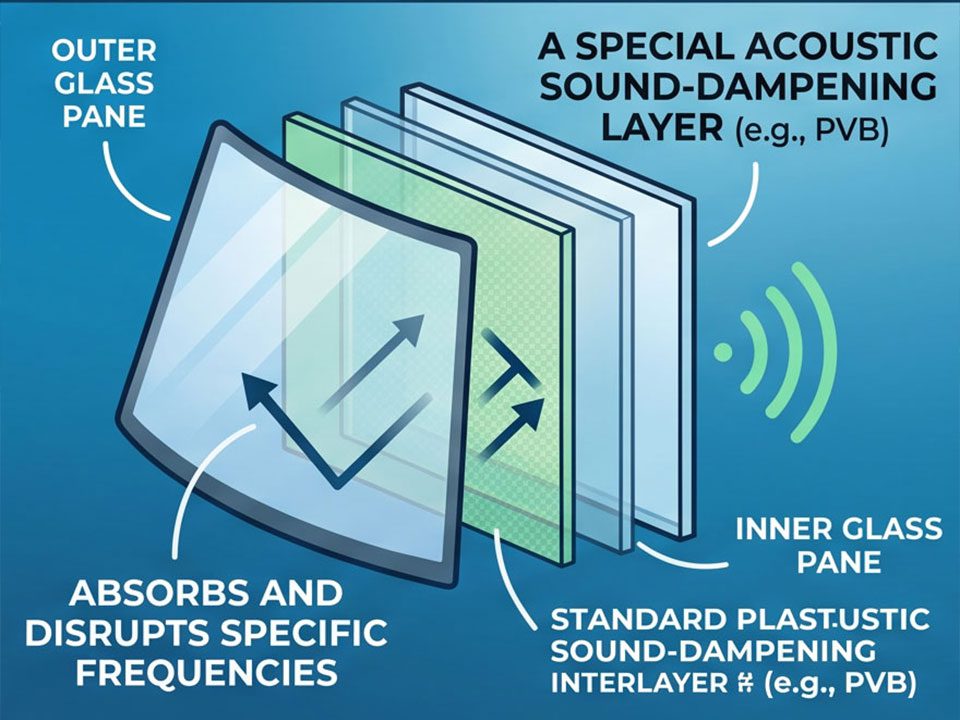
As we’ve covered in previous posts, traditional laminated automotive glass contains a plastic interlayer between two panes of glass. Acoustic glazing takes this principle further by placing a specially engineered sound-dampening layer, often based on Polyvinyl Butyral (PVB), between the glass panes of the windscreen. This special interlayer is designed to absorb and disrupt certain sound frequencies before they pass into the cabin.
The result is a quieter interior, particularly at motorway speeds where wind and tyre noise can otherwise become prominent. For an EV manufacturer, this isn’t simply about making the cabin feel more luxurious. A quieter cabin can also make it easier for occupants to hear audio systems, conversations and navigation instructions without increasing volume.
Furthermore, as EVs become quieter, small noises that might have gone unnoticed in an older vehicle can become much easier to hear. A damaged seal, poorly fitted trim or minor wind noise can really stand out in an otherwise silent cabin.
In essence, this means that – to manufacturers- the windscreen is increasingly being considered as part of the vehicle’s acoustic environment rather than simply a transparent barrier between the driver and the outside world.
Common Misconceptions About Electric Vehicles >>
Heavier Vehicles, Stronger Glass: Structural Integrity in an EV Era
Electric vehicles usually weigh quite a bit more than comparable petrol or diesel vehicles due to the substantial size of the battery packs required to store electrical energy. Depending on the models being compared, an EV can be around 25% to 30% heavier than an equivalent combustion-engine car.
This additional weight brings with it various implications for vehicle engineering and crash performance. As you might expect, when a heavier vehicle is involved in a collision, the forces involved can be substantial, placing significant demands on the vehicle’s body and its structural integrity as a whole.
The windscreen is an important part of this very structure. As we’ve covered, modern laminated windscreens are bonded directly into the vehicle body and contribute to the car’s overall rigidity. They also play an important role in maintaining the passenger compartment during certain types of collision, most notably in the event of rollover situations.
That is to say that your windscreen isn’t simply there to keep rain and wind outside. If it is correctly bonded into the vehicle it becomes part of the engineered structure of the car.
All of this adds to make the quality of a replacement windscreen and the their installation extremely important. When an EV windscreen is replaced, specialist technicians need to use the appropriate high-performance polyurethane adhesive and closely follow the manufacturer’s installation requirements.
These same principles apply to electric vehicle auto glass more broadly. Different EV models can use different types of glass, adhesives, mounting systems and even sensor configurations. That is to say that two windscreens that look identical to the untrained eye may in fact have very different technical requirements and characteristics.
Does a cracked windscreen affect an EV’s structural safety?
Yes. A cracked windscreen stands to significantly compromise your glass’s structural performance. Because EVs can be considerably heavier than comparable conventional vehicles, maintaining the integrity of the vehicle’s safety structure is of vital importance. Damaged glass should be assessed and repaired or replaced where necessary.
Aerodynamics and Stone Traps: Why EV Shape Alters Impact Risk
Efficiency is one of the central operating principles in modern EV design. Manufacturers work hard to reduce aerodynamic drag because using less energy to push the vehicle through the air can help maximise driving range.
This has resulted in some very sci-fi inspired, super streamlined designs. Models such as the Tesla Model 3 and Hyundai Ioniq 6 feature smooth bodywork, low drag profiles and steeply sloping front-end designs.
One quirk of these new designs is that their aerodynamic shapes can also change how air and road debris move around the vehicle.
On a conventional vehicle with a more upright front end, loose stones and other road debris kicked up by your fellow motorists can usually strike the bonnet or other bodywork before reaching the windscreen. On a highly aerodynamic EV, the airflow is carefully directed around the front of the vehicle. In some circumstances, that can help carry loose particles upwards towards the windscreen.
Don’t worry! This doesn’t mean every EV will suffer more chips, but the combination of vehicle shape, road conditions, tyre position and aerodynamic airflow can certainly play their part in determining where debris ends up.
For EV drivers, this means dealing with small chips promptly should be a top priority A tiny impact may initially appear harmless, but temperature changes, vibration and further impacts can cause existing damage to spread.
A professional chip repair can often prevent a minor defect from becoming a much larger problem, it’s always worth having it assessed by a professional rather than waiting to see what happens.
HEV, PHEV or EV – what should I go for? >>
Panoramic Glass Roofs and EV Range Thermal Management
One particularly notable design trend in the world of EVs is expansive panoramic glass roofs.
Large areas of glass can make an EV cabin feel brighter and more spacious while allowing designers to create a sleek interior without having to account for the bulk of a conventional roof structure. The downside is heat.
A large glass surface can allow significant solar energy into the cabin, particularly when a vehicle is parked in direct sunlight. The hotter the interior becomes, the more work the climate-control system has to do to bring temperatures back down. In an EV, that energy ultimately comes from the same battery used to power the vehicle, potentially affecting available range.
This is where specialised glass treatments come in. Low-emissivity, or Low-E, coatings and infrared-reflective layers can help reduce the amount of solar heat entering the cabin. These technologies aim to improve passenger comfort while reducing the burden placed on the vehicle’s climate-control system.
For owners with panoramic roofs on their EV’s, it is important to remain cognisant of the technologies present in their car glass. Abrasive cleaning products, harsh tools or unsuitable chemicals could potentially damage surface treatments or coatings.
Try to use products recommended by the vehicle manufacturer and a clean, soft cloth when cleaning your panoramic glass. Avoid aggressive scraping or abrasive compounds unless the manufacturer specifically approves them. It’s also worth casting an eye over the condition of seals and surrounding trim during routine cleaning.
Connected Windscreen Tech: Cameras, Lidar, and Advanced ADAS
Essentially, modern vehicles, especially those of the electric variety, are for all intents and purposes computers on wheels. With that in mind, it is crucial not to forget that a great deal of technology can often be situated around the windscreen.
Look behind or around the upper section of many modern windscreens and you’ll find a collection of sophisticated components. Forward-facing cameras can support lane keep assist, lane departure warning, traffic sign recognition and automatic emergency braking. Rain sensors can control automatic wipers, while light sensors and auto-dimming systems can adjust the vehicle’s response to changing road or weather conditions.
Some newer vehicles are even incorporating advanced sensing hardware, including lidar-related technology.
The level of technology involved makes for a number of important considerations whenever EV windscreens are replaced. The position of a forward-facing camera relative to the road is extremely precise. Even a very small change in its mounting position or angle can affect what the vehicle’s computer understands itself to be seeing.
That’s why windscreen calibration is such an important part of modern glass replacement. After a windscreen is fitted, the vehicle’s ADAS system will need to be checked and recalibrated according to the manufacturer’s requirements.
This process involves specialist calibration equipment, precise positioning of targets and, depending on the vehicle, a combination of static and dynamic calibration. Our specialist technicians need to ensure the camera and associated systems are correctly aligned before the vehicle can safely return to the road.
For EV owners, this is another example of how electric vehicle auto glass has evolved beyond the traditional concept of replacement glass. The windscreen is now best understood as part of a sophisticated network of sensors and electronic systems, meaning the quality of the glass, installation and calibration are all of vital importance to keeping you and your passengers safe.
What to consider before buying your First Electric Car >>
Frequently Asked Questions
Q1: Are EV windscreens more expensive to replace than normal windscreens?
Yes, they can be. EV glass may include acoustic interlayers, solar-reflective coatings and complex camera mounts. Some vehicles also require ADAS calibration after replacement, adding technical work to the process.
Q2: Can you repair a minor chip on an EV windscreen?
Yes, in many cases. Small chips can often be repaired with structural resin. Suitability depends on size, location and severity. Damage directly within the camera’s viewing area may require additional assessment.
Q3: Will running my windscreen demister drain my EV battery?
Yes, it can use battery energy. However, modern EVs can use efficient heating systems and some models feature electrically heated glass. These technologies can clear frost quickly without relying entirely on cabin heating.
EVs are changing almost every aspect of vehicle design, and the windscreen is no exception. From acoustic windscreen glass and solar-control coatings to sophisticated camera systems and stronger structural requirements, modern glass has become an important piece of automotive engineering.
For drivers, that means an EV windscreen should be treated as a precision component rather than a simple replacement part. Correct glass specification, professional installation and windscreen calibration all have a part to play in ensuring the vehicle continues to perform as designed.
So, the next time you are peering through your windscreen at the road ahead, remember: you’re not just looking through a piece of glass. You’re looking through a carefully engineered component that helps keep you safe, comfortable and connected to the technology all around you!
We hope you found this exploration into the world of EV glass informative and crystal clear! Check back with the Autoglass® Ireland Blog soon for more explainers, tips and motoring guides.
Safe travels!
Book an appointment now
For a quick and easy way to make an appointment book online now.